

Meet Your Fellow Members
This series celebrates the people behind the profession and offers an opportunity to learn from and connect with MRTs working in a wide range of settings from coast to coast! Every Monday, we’ll introduce you to a different medical radiation technologist from somewhere across Canada.
| Know someone we should highlight? Let us know at maiello@camrt.ca |
This week’s member spotlight is Halee Rodgers H.BSc MRT(R)(CTIC).

Can you describe your current role and area of practice within medical radiation technology?
I am currently a Medical Radiation Technologist specializing in CT and X-ray in the Hamilton/Halton region of Ontario.
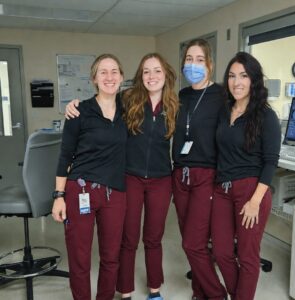
What originally led you to pursue a career as an MRT?
I’ve always considered a career in health care. My family and I were in and out of hospitals growing up, and I was constantly so impressed and intrigued by all the staff I encountered. However, I never really knew what I wanted to do, since I didn’t really feel drawn to nursing or medicine, and I wasn’t aware of all the many disciplines that exist in the health care field. It wasn’t until, by fluke, I attended an information session on the Medical Radiation Sciences program at McMaster University that I even knew of or considered Radiology as a field. And I can honestly say it’s one of the best chance encounters I’ve ever had.
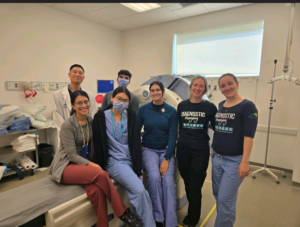
What does a typical day look like for you in your department or clinic?
A typical day at work is pretty crazy. I work at a couple different hospitals, but the work is the same no matter where I am. It’s just a non-stop jumble of prepping outpatients, making or answering phone calls about inpatients, and clearing the room for stat cases from the ER. I think a lot of people have this incorrect assumption that we just image patients all day long and that’s our entire job, but it’s only a fraction of it. We are responsible for the patient from the moment they enter the department to the moment they leave. There’s so much that goes into making sure a patient is ready for their test, protocolling and ensuring we’re doing the correct test for the clinical provider, monitoring the patient to ensure there are no adverse reactions, and then double-checking the images to make sure we have everything we need. We are doing multiple things at once, all while ensuring we never take our eyes off the patient while they’re in the room. It’s a lot, and it’s a lot that I find often gets taken for granted. It’s a super rewarding career, but it certainly isn’t an easy one either.
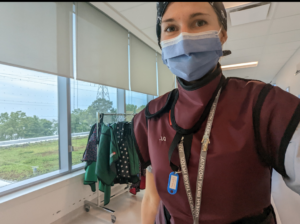
What advice would you give to new MRTs entering the profession today?
Have confidence in yourself. You passed that exam, you know your stuff, and there’s going to be a lot of moments where you must make quick decisions on your own. Being confident in your knowledge and training will go a long way to helping you stand up for your decisions and advocating for the patient. But also, never be afraid to ask for help. We are supposed to be an interdisciplinary system that helps and supports one another, and a lot of mistakes can be prevented if we all help each other out.
What aspects of your work do you find most rewarding?
The most rewarding part of my job is just helping the patients. If someone comes in with major claustrophobia, and I can help them get through their CT scan by simply talking to them, explaining the process, and being a reassuring presence through the mic, then that’s a great day for me.
What is your favourite part about being an MRT?
I think my job is pretty cool overall. I love putting in IVs for CT scans, going up to the floor to do portables, or seeing fracture repairs in the OR. My favourite part is probably imaging. To this day, I still get excited when I see a cool case or a new pathology, and I love that I’m in a field where even after so many years, I’m still able to learn new things.