
Meet Your Fellow Members
This series celebrates the people behind the profession and offers an opportunity to learn from and connect with MRTs working in a wide range of settings from coast to coast! Every Monday, we’ll introduce you to a different medical radiation technologist from somewhere across Canada.
| Know someone we should highlight? Let us know at maiello@camrt.ca |
This week’s member spotlight is Heather Gaunt, MSc., BTech. (RT), RTT.
- Can you describe your current role and area of practice within medical radiation technology?
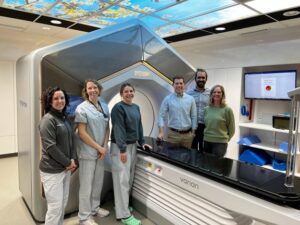
Currently, I am a clinical educator in radiation therapy, working alongside two other educators with the aim of supporting radiation therapists, students, patients, and the interdisciplinary team. Day-to-day, that means responding to staff requests for information and resources that support their clinical practice; training skills and new techniques; orienting people to the work we do and the ways we do it here in Kelowna. When I’m clinical, still on the treatment floor, I get to stay close to patient care and technical expertise that makes radiation therapy rewarding.
- What originally led you to pursue a career as an MRT?
The original inspiration came from my grandfather, who had watched my cousin pursue radiation therapy and enjoy it. This same grandfather also underwent several courses of radiation therapy for his lymphoma, and he told me that the RTs were “all smart and smiley like you,” so he thought I should try it. Talking to my cousin about the profession and a tour with BC Cancer on Vancouver Island, it seemed that RT was the right blend of people-work and science for me.
- What does a typical day look like for you in your department or clinic?
A typical day includes working on the treatment floor with students, while also providing relief and guidance for radiation therapists on teaching and learning in the clinical environment. This means answering lots of “what if” scenarios, helping people through tough conversations or feedback, and enjoying the chance to contribute to patient treatments and patient care. I also get to create and run different courses, workshops, and learning rounds where ideas get shared and hopefully cultivate continuing competence and professional development.
- What advice would you give to new MRTs entering the profession today?
Take responsibility early on to grow your competence, healthy connections, and autonomy within the work environment wherever and however you can. For me, this meant moving around from clinic to clinic for the first 11 years of my career. I gathered experience, perspectives, different tools, and approaches to patients – it was richer and more interesting and suited my personality. The reality is 30-35 years is a LONG time to be working in one thing, and learning early how your personality, preferences, and attitudes can work with your profession, not against it, can help keep you energized and motivated.
- What aspects of your work do you find most rewarding?
Getting paid to hang out with my best friends is rad. This career has gifted me amazing people (including my spouse!), and I keep that in perspective when the grind of frustrations or burnout threatens. I can’t solve all the problems that patients have, or the system has, or my students have, and that weight can feel heavy if I let it. Appreciating the people who are there every day to laugh with, or rant with, is a powerful driver of my satisfaction.
- What is your favourite part about being an MRT?
The best part of being an MRT is practically contributing to something that improves a patient’s life. They might not see it that way, for a million different reasons, but when I take that image and see that their lung tumour has disappeared, or their neck mass is shrinking, or they need only 5 treatments now instead of the 35 they needed 10 years ago, I get that hit of motivation and satisfaction to keep going.