
Meet Your Fellow Members
This series celebrates the people behind the profession and offers an opportunity to learn from and connect with MRTs working in a wide range of settings from coast to coast! Every Monday, we’ll introduce you to a different medical radiation technologist from somewhere across Canada.
Know someone we should highlight? Let us know at maiello@camrt.ca
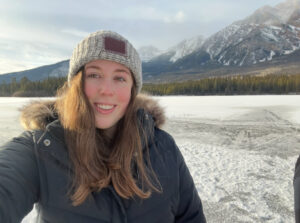
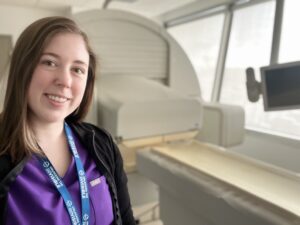
This week’s member spotlight is Morgan Longland, MRT (NM)(MR), Nuclear Medicine Team Lead, currently working in Edmonton, Alberta at MIC.

Can you describe your current role and area of practice within medical radiation technology?
Currently, I am working as a Nuclear Medicine Technologist, as well as an MRI Technologist, in a Clinic setting in Alberta. My full-time role is Nuclear Medicine Team Leader, and I work casually in our MRI department as well. I am responsible for supporting our day-to-day operations, staff scheduling, performance reviews, creating patient scheduling templates, maintaining records, ensuring we are up to date on equipment maintenance as well as I am also working on the floor with patients.
What originally led you to pursue a career as an MRT?
I always knew I wanted to do something in healthcare, but I also wanted to find something that had a strong involvement with technology alongside the patient care aspect. I did some research into healthcare programs in my province at the time (BC) and discovered the different medical imaging modalities, which caught my interest. I applied to the BCIT Nuclear Medicine Program as it sounded intriguing. The idea of working with radiation was a bit scary at first, but I figured if people do this for a living, it must be safe in some sense. The different types of tests, as well as therapies that are a part of the Nuclear Medicine world, provide a vast range of things a technologist might do on a day-to-day basis. Through my research and acceptance into the program, I moved away from home and began my MRT journey at BCIT. A couple of years into working as an MRT, I applied to the NAIT 2nd Discipline MRI program as I had a passion to pursue MRI as an additional modality. I was accepted, finished in about 18 months, and began working in both Nuclear Medicine and MRI. This provided a bit of variety for me from day to day, challenging my brain, as well as getting to know a completely new group of technologists with whom I got the opportunity to work.
Can you tell us about a typical day in your department?
In Nuclear Medicine, we start early to get our equipment ready for the day. In our clinic, we receive our radiopharmaceuticals every morning from a central radiopharmacy in Edmonton, so upon arrival, we must receive the radioactive package and ensure the package is free of any radioactive contamination. We also perform quality control on our cameras and dose calibrator to prepare to be able to draw doses and scan our patients. Typically, our patients begin arriving around 7:30 am, so we must start early to prepare the department for the day. We do myocardial perfusion stress testing multiple days a week, so in the morning, we are preparing the stress lab, setting up IV’s, drawing doses, and working directly with a Cardiologist to perform the stress tests, either as a treadmill test or with pharmaceutical intervention. We also typically have our “rest” patients returning in the morning (patients who had their stress test the day prior), so we are injecting them around the same time. The department is quite busy in the mornings due to the number of injections, and all those patients also require scans on one of our 2 gamma cameras. We almost always have bone scans as well, so someone is injecting them throughout the morning/early afternoon, and those patients return 2.5-3 hours post-injection for their imaging.
By the afternoon, things have slowed significantly, as there are no more injections to be done. At this time of day, things are more predictable and calmer than our busy mornings. We can just focus on our returning patients for their scans, prepare paperwork for future patients, and order our radiopharmaceuticals for the following day.
When I am not active in the department, I am involved in meetings, planning, and scheduling tasks to maintain the flow of our day-to-day operations as well as plan for future projects.
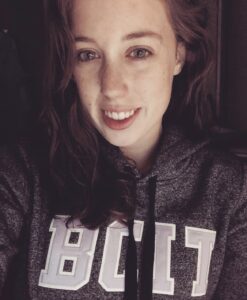
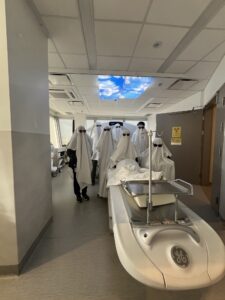
“This BCIT hoodie was at the end of the first month of my first year of the Nuclear Medicine Program!”
What is your favourite part of the job?
I enjoy being a part of a patient’s journey to find answers. I take time to gather relevant information from each patient for their exam, and I find that giving them a little bit of time and space to share their concerns and answer their questions in a detailed manner can provide them with a sense of security, in that they feel heard and understood. You can typically see some relief from them once they finally feel like someone is listening to them, and you have eased their nerves about the test.
The feedback we receive directly from our patients gives us all even more motivation to continue to do what we love doing.
We are participating in research trials where we are seeing the same patients returning on a routine basis every few months. I enjoy being able to play a role in new pharmaceutical research, and these patients are the most grateful for the entire team, no matter how small a role we think we might play in the process.
I also enjoy the people I get to work with directly. From other imaging departments, the bookings team, radiologists, and reception staff, everyone enjoys what they do and has a passion for helping patients.
Do you have any advice for new or practising MRT’s?
For new technologists, know where your resources are (protocol manuals, policies, emergency procedures, helpful colleagues!) and use them. Any spare time you have, do some reading. Refer to them whenever you need to; they are there for a reason! You do not graduate and stop learning. If there is something you are uncomfortable doing, ask an experienced tech if you can watch them do the next one, or have them assist you while you attempt it.
A new grad with a positive attitude is way better to work with than an experienced tech who isn’t part of the team. Offer to help where you can and offer to observe where you feel uncomfortable. Put yourself in situations you feel insecure in to gain the experience needed to feel confident in that task. Also, don’t be afraid to apply for positions you don’t feel qualified for. If it’s something you are passionate about, make it known; you just might surprise yourself.