
Meet Your Fellow Members
This series celebrates the people behind the profession and offers an opportunity to learn from and connect with MRTs working in a wide range of settings from coast to coast! Every Monday, we’ll introduce you to a different medical radiation technologist from somewhere across Canada.
Know someone we should highlight? Let us know at maiello@camrt.ca
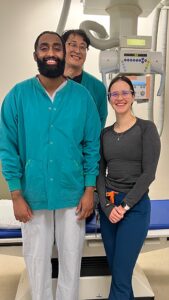
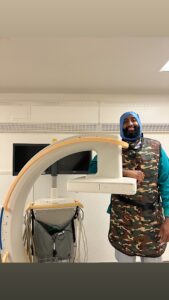
This week’s member spotlight is Omer Hussein, BHSc, MRT (R), from Northern Lights Regional Health Centre in Fort McMurray, Alberta.
What first inspired you to pursue a career in medical radiation technology, and what’s kept you passionate about the field over time?
I did not start my career in healthcare. I began as a safety officer in the oil industry, where my role focused on preventing injuries. Over time, however, I began to notice the same pattern. When people did get hurt, almost every one of them required some form of medical imaging as part of their care.
I recall reading a statistic that nearly 80 percent of patients who visit an emergency department require imaging to complete a diagnosis. That stayed with me. It made me realize how central imaging is to the healthcare system, especially during moments when people are vulnerable and looking for answers.
I wanted to be part of that process. I had spent years trying to help people avoid getting injured, and this felt like a way to help them once they were hurt, during their recovery and diagnosis. Moving into medical radiation technology felt like a natural extension of that purpose.
Even now, that sense of meaning is what keeps me in the profession. You are right at the edge of the unknown. And it hits you when a patient, searching your face for clues, asks what you saw. In that moment, you understand just how central you are to their journey.
How has your identity shaped your journey in medical radiation sciences?
I love this profession. It has given me stability, purpose, and people I care about.
Being a Black healthcare professional has made me more aware of the structural inequities that exist within the healthcare system. That awareness did not push me away from the work. It made me more curious about how the profession functions and how decisions are made.
That curiosity is what drew me into involvement beyond the clinical space, including governance and policy work. I wanted to better understand the structures that shape professional practice and patient experience. I was fortunate to work with a manager and leadership team who were supportive, which made it easier to stay engaged, ask questions, and stay involved.
More than anything, my identity sharpened how I listen, how I show up for patients, and how I move through clinical spaces.
What’s a small win during a workday that can instantly make it a good shift?
Sometimes a good shift comes down to something simple. A patient recognizes you from a previous exam, and there is an instant connection. In that moment, you realize you built enough trust to be remembered.
It is a small thing, but it matters. It tells you that you were present, that you made an impact on someone’s care, and that the way you showed up stayed with them. Those moments have a way of setting the tone for the rest of the shift.
What advice would you give to students or early career professionals considering medical radiation technology?
I would tell them that this is a profession with an incredible amount of range. Medical radiation technology is not one job or one setting. It can take you from the operating room to the emergency department to a local community clinic. It can open doors to different specialties, different environments, and even opportunities to work across regions or travel. Few healthcare professions offer that kind of growth and movement.
Right now, the profession is facing a real human resource crisis. The need for MRTs has never been higher in my career. We need people with empathy, people who listen, and people who are willing to go a little further for patients and for each other. That is what makes the profession what it is.
I would also tell them that they belong. Black professionals have long been part of this field. What is changing now is visibility and acknowledgment, and that matters because representation helps people see themselves reflected and belonging here. Your empathy, your ability to listen, and your lived experience are not extras. They are strengths that this profession needs.
Who or what has had the biggest influence on your professional growth so far?
When I look back, my growth really comes down to people who believed in me and kept that belief going.
Cora Therrien was the first person who gave me a chance and trusted me early on. That kind of belief matters when you are still figuring things out. Tracy Peers carried that belief forward, continuing to support me as I grew into the role and encouraging me to keep developing along the way. That consistency made a real difference.
My colleagues have also had a huge influence on me. Working in Fort McMurray meant working alongside technologists from all across the country, from Newfoundland and New Brunswick to Ontario and British Columbia. Together, they made our department feel like a home away from home.
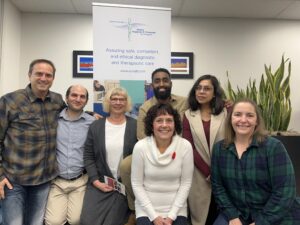
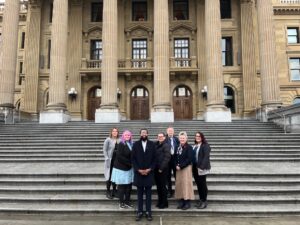
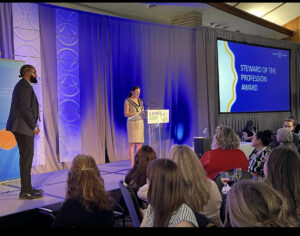
Outside the department, I was supported by people who encouraged my curiosity beyond the clinical space. Pree Tyagi supported my interest in governance and health policy. Through CAMRT Alberta, Gina McRae gave me opportunities to grow my voice through advocacy and lobbying work. And Jenna MacLaine recognized my contribution to the profession by honouring me with the Steward of the Profession award.
More than anything, my growth has been shaped by people who believed in me, made space for me to learn, and helped me feel like I belonged.